Privacy-Safe Library Analytics

Trovak was founded to eliminate a ubiquitous campus friction point: students wasting valuable study time wandering through multi-floor university libraries searching for open seats. By engineering an automated physical infrastructure, Trovak streams live desk-level availability metrics straight to students.

The Core Differentiator: Total compliance and absolute privacy safety. By completely eschewing cameras, optical arrays, and biometric data logging, the system relies strictly on radar, thermal arrays, and infrared tracking metrics—making institutional compliance seamless.

The Division of Labor: As the Co-Founder and Lead Hardware Engineer, I completely own the physical hardware stack—spanning product architecture, schematic capture, multi-layer PCB layout routing, and mechanical packaging. My co-founder directs our high-level cloud infrastructure, software engineering suites, and backend pipelines.

Multi-Layer and Complex PCB Design CAD Design ESP-NOW Mesh Hardware Architecture

Trovak venture flagship vector brand schematic architecture diagram

The Hardware Roadmap


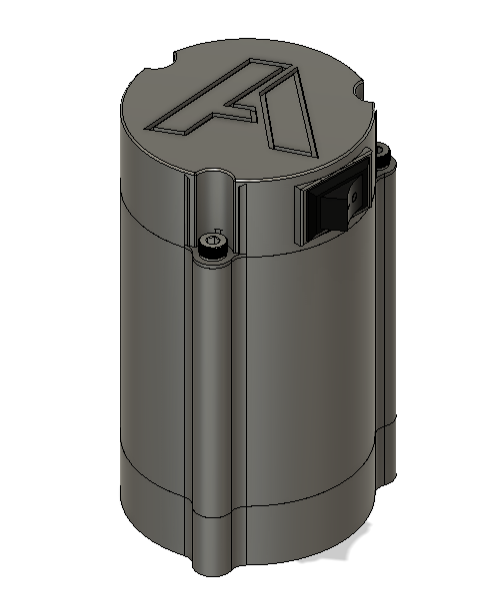
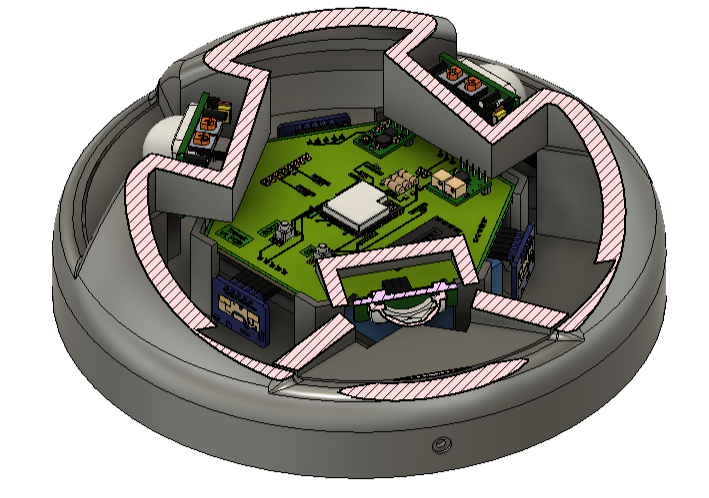
Trovak Version 1.0 prototype featuring an ESP32-S3 development board inside an arrayed cylindrical capsule housing
Version 1.0 — Prototype

Cylindrical Dev-Board Capsule

The original proof-of-concept focused strictly on validating sensor data viability. Built around an off-the-shelf ESP32-S3 development board, the system was packaged into a compact cylindrical capsule housing three arrayed LD2410C millimeter-wave radar sensors. This unit successfully proved that micro-movement tracking could accurately identify stationary human occupants without cameras.

Trovak Version 2.0 integrated monolithic circuit board with custom ESP32-S3-WROOM-1U layout
Version 2.0 — Optimization

Optimized Custom PCB

To transition away from loose prototyping wires and reduce assembly times, I designed a custom PCB utilizing an ESP32-S3-WROOM-1U module. This layout engineered a robust hardware tracking matrix, combining three LD2410C radar sensors with three passive infrared (PIR) sensors for hardware-level sensor fusion, massively reducing false positives while optimizing system power consumption.

Trovak Version 3.0 production architectural deployment showing modular decentralized component layout
Version 3.0 — Production-Ready Architecture

Decentralized Mesh & ML Architecture

Version 3 represents a ground-up architectural restructuring into an enterprise-tier network. The hardware responsibility is decentralized across an ecosystem of specialized, purpose-built components. By dividing tasks into a dedicated sensor pod, routing anchors, and an edge processor, the network achieves unparalleled battery life, infinite workspace scalability, and hyper-accurate mapping capabilities. Additionally, every part of the system is designed for compactness and ease of installation, with plug-and-play modularity and a minimal physical footprint.

V3 Core Multi-Board Subsystems

PCB-V3

A technical deep-dive into the three distinct printed circuit boards I designed, routed, and tested to support Trovak's decentralized system topology.

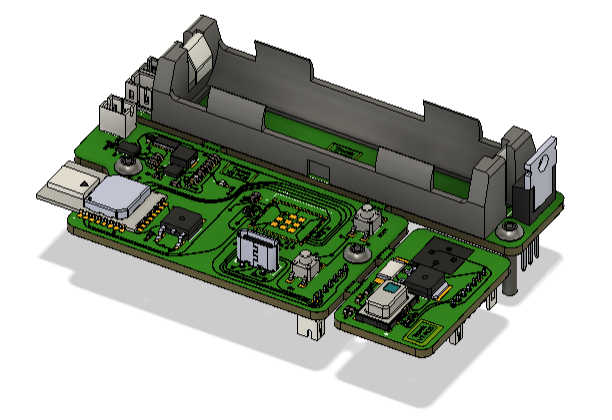
Trovak custom main sensor end-node printed circuit board featuring ESP32-C6 Mini daughterboard and Panasonic Grid-EYE thermal sensor tracking arrays

1. Main Sensor End-Node

The primary low-power capture element. Features a specialized daughterboard structure housing an ESP32-C6 Mini for energy-efficient native Thread/Zigbee communications, an ultra-precise Panasonic Grid-EYE infrared array thermal sensor, one micro-PIR sensor, and full integration for an 18650 lithium cell battery with optional Ultra-Wideband (UWB) tracking channels.

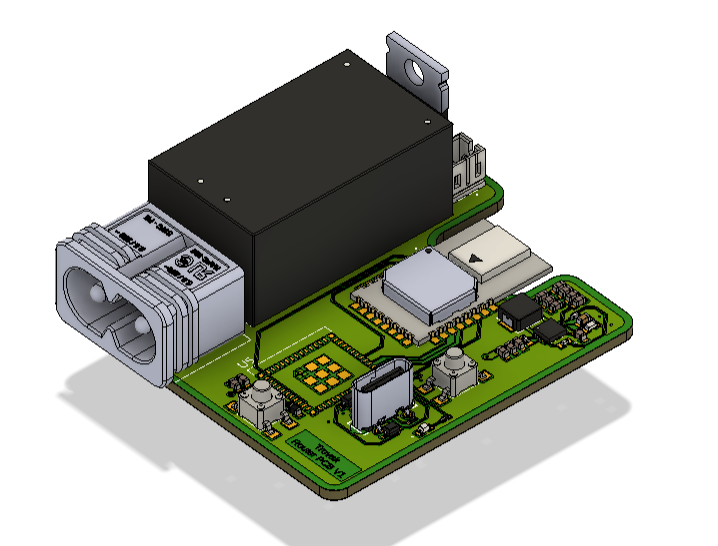
Trovak mesh network router anchor PCB with embedded ESP32-C6 Mini and integrated UWB spatial tracking transceiver components

2. Mesh Router Anchor

Engineered to handle structural campus range extensions. This hardware layer utilizes an ESP32-C6 Mini integrated alongside dedicated Ultra-Wideband (UWB) spatial tracking transceivers. Formatted as a streamlined "wall-wart" enclosure geometry, it plugs directly into standard institutional outlets to pass data packets across the local mesh web.

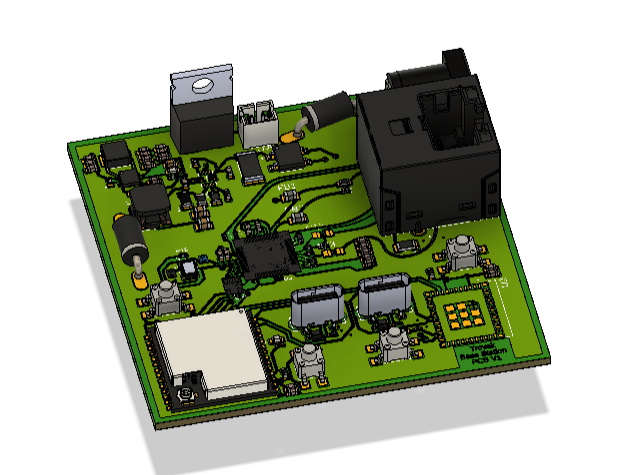
Trovak intelligent base station controller master circuit design combining an asymmetric co-processing layout with an ESP32-C6 Mini and ESP32-S3

3. Intelligent Base Station

The high-power master controller for the physical installation site. Features an asymmetric co-processing design pairing an ESP32-C6 Mini (handling incoming raw mesh data packet streams) directly with an ESP32-S3. The S3 processes these inputs through our custom machine learning classification model to confirm true occupancy states and update the public floor seating map.